

His name is Arlo, and for the first three years of his life, he was the most exhausting thing I have ever loved.
I got him when I was twenty-six, living alone, working from home, with what I thought was plenty of time and energy for a dog. He was a husky mix — one of those breeds you see on lists with warnings attached. I'd read the warnings. I thought I was prepared.
I was not prepared.
By the end of year one I had a dog that could not, under any circumstances, relax. I walked him every morning. Took him to the park on weekends. Bought every enrichment toy the internet recommended. Some of them he destroyed within minutes. Some of them he ignored completely. He'd come home from a walk and immediately start pacing. Start whining. Start looking for the next thing, and the next thing, and the thing after that.
The worst part wasn't the energy. It was the guilt. I kept thinking I wasn't doing enough. That I wasn't the right kind of owner for a dog like this. That maybe he deserved someone with a garden, a farm, a different life than the one I could give him.

The turning point
What a behavioural trainer said that nobody had ever told me before
In year three I finally hired a professional dog trainer — not a group class, a one-on-one session with someone who specialised in high-drive working breeds. She watched Arlo for about ten minutes, asked me a few questions about his daily routine, and then said something I have never forgotten.
"You're meeting his physical needs. You're not meeting his cognitive ones. And for a dog like this, cognitive need is the bigger problem."
I didn't fully understand it at the time. So she explained it.
She gave me a list of things to try. Nose work. Puzzle feeders. Changes to how I fed him. The idea was to take moments that already existed in Arlo's day and make them cognitively meaningful — instead of passive, empty moments where nothing was asked of his brain.
The science behind it
Why mealtime matters more than most owners realise
The trainer explained that mealtime is one of the single most wasted enrichment opportunities in a dog's daily routine. Most dogs inhale a meal in twenty to thirty seconds. That's twenty to thirty seconds of zero cognitive engagement, happening twice a day, every single day of the dog's life.
When you extend that to five or ten minutes of slow, deliberate foraging — when the brain is actually working to access the food, engaging the same instincts that fired when dogs hunted and foraged in the wild — something biochemical happens. Serotonin and dopamine release. The brain's reward pathways activate. The nervous system downregulates. The dog doesn't just get full. They get satisfied, in a way that runs much deeper than the meal itself.
What actually changed things
The Magic Brush Slow Feeder Bowl — and what happened in the first week
Among the changes I made based on the trainer's advice, switching to the Magic Brush Slow Feeder Bowl was the simplest — and the one with the most immediate visible effect.
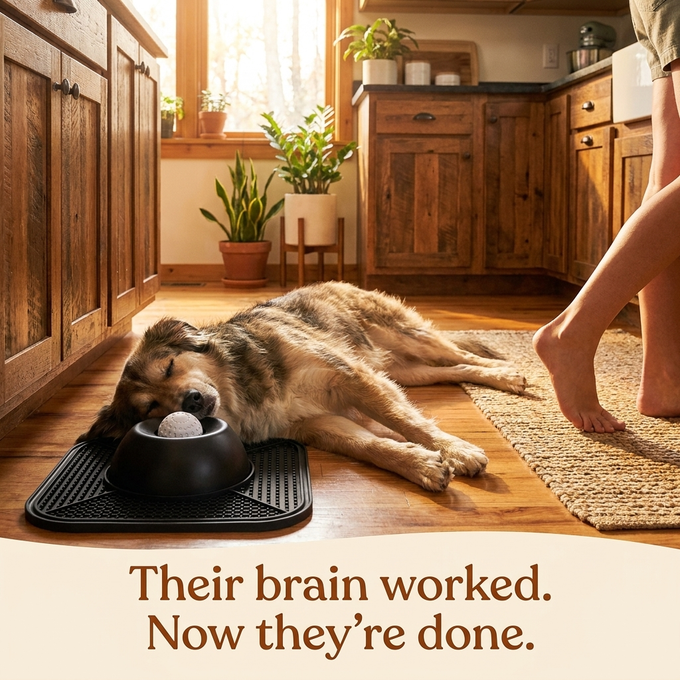
Where Arlo had been finishing meals in about 25 seconds, he now spends 8 to 10 minutes engaged with every feed. The design requires him to slow down, to work, to stay focused. His foraging instincts — the ones that were running on empty and generating chaos — are getting exercised twice a day now, in a contained and satisfying way.
Within the first week, I noticed he was lying down after meals. Not immediately pacing or looking for the next thing. Just lying down. It sounds small. It wasn't small. It was the first time in three years I'd watched him finish eating and genuinely rest.
The effect has compounded since then. The evening pacing has reduced significantly. He settles more easily after walks because the baseline — the neurological baseline — has shifted. A brain that's been given what it needs twice a day is a brain that's easier to calm at other times too.
He's still Arlo. Still energetic. Still a lot of dog. But I'm not failing him anymore. And I'm not spending every evening watching him spiral because I couldn't figure out what he needed.
The bowl is available in Black or Blue, with or without a Non-Slip mat. Dishwasher safe. Backed by a 30-day money-back guarantee. And it costs less than a single session with the trainer who finally told me the truth.
